
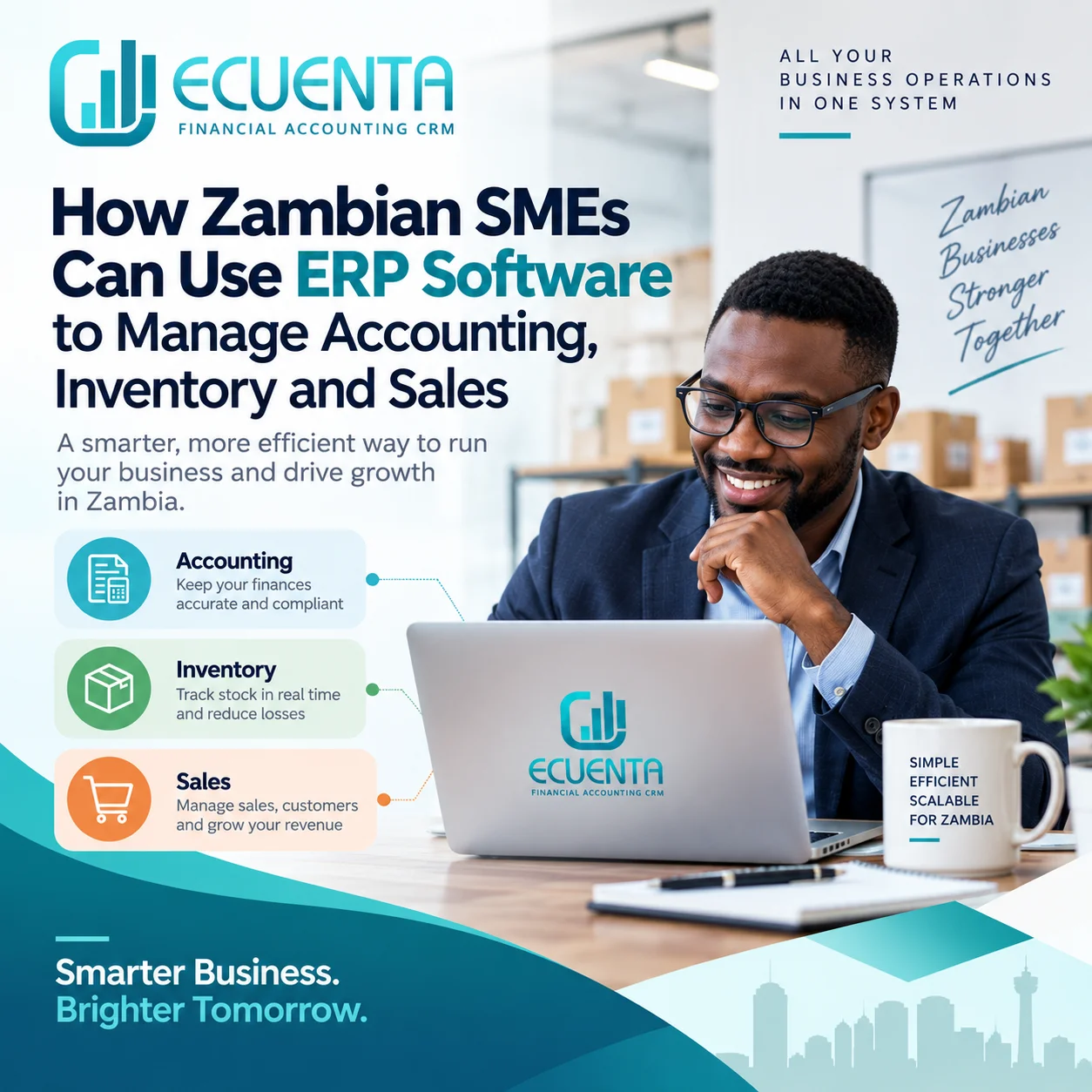
How Zambian SMEs Can Use ERP Software to Manage Accounting, Inventory and Sales
For many small and medium-sized enterprises (SMEs) in Zambia, managing accounting, inventory and sales becomes increasingly difficult as the business grows. Spreadsheets, paper records and separate software may work when a business is small, but they can create duplicated work, data errors and limited visibility as transactions increase.
This is where ERP software for SMEs in Zambia can make a significant difference. An ERP system brings important business processes together in one platform, allowing business owners and managers to manage financial records, stock, sales, purchases and reporting from a connected system.
Ecuenta is designed as an all-in-one business management and accounting platform, combining accounting, ERP, inventory, CRM, POS, payroll and ZRA Smart Invoice functionality.
What Is ERP Software?
ERP stands for Enterprise Resource Planning. ERP software connects different areas of a business so information can be managed from a central system.
Instead of using one application for accounting, another for inventory and spreadsheets for sales, an ERP system can connect these processes.
For a growing Zambian SME, this can mean:
- Recording sales and invoices
- Tracking inventory and stock movements
- Managing purchases and suppliers
- Monitoring income and expenses
- Managing accounts receivable and payable
- Generating financial reports
- Connecting sales information with accounting records
- Supporting ZRA Smart Invoice requirements
The objective is to give business owners and managers a more complete view of business operations.
1. Use ERP Software to Simplify Accounting
Accounting is one of the most important areas of any business. However, manually recording transactions can take considerable time and increase the possibility of errors.
An integrated ERP and accounting system can help SMEs organize financial information in one place. Ecuenta provides accounting functionality including chart of accounts, journals, ledgers, invoices, financial reporting, receivables and payables.
With an ERP system, a business can use sales and purchase information as part of its wider financial records rather than entering the same information repeatedly into different systems.
Business owners can also use financial reports to understand revenue, expenses, receivables, payables and other financial information when making business decisions.
For SMEs, better access to financial information can help management monitor the business more systematically.
2. Manage Inventory in Real Time
Inventory management is another major challenge for growing businesses.
Poor stock management can result in:
- Overstocking
- Stock shortages
- Expired products
- Unrecorded stock movements
- Difficulty identifying fast-moving products
- Differences between physical stock and recorded stock
Inventory management software in Zambia can help businesses maintain better visibility of their products.
Ecuenta's inventory functionality is designed to help businesses track inventory, manage orders and warehouses, monitor stock levels and identify fast-moving or potentially expiring items.
For example, a retail business can record products entering the warehouse and monitor sales as stock leaves the business. Managers can then use inventory information to understand which products require replenishment.
This becomes especially useful for SMEs handling hundreds or thousands of products.
3. Connect Sales With Inventory
One of the biggest advantages of an integrated ERP system is that sales and inventory do not have to operate as completely separate processes.
When a product is sold, the transaction can be connected to inventory records. This gives managers a clearer picture of sales activity and stock movement.
Ecuenta's sales management module supports sales orders, invoices, customer payments and refunds, while its inventory functionality supports stock and inventory management.
For a Zambian SME, connecting these processes can reduce duplicate data entry and make it easier to monitor business activity.
For example:
Customer order → Sales invoice → Stock movement → Accounting record → Financial report
Connecting these steps helps create a more consistent flow of information across the business.
4. Improve Purchase and Supplier Management
Inventory management starts with purchasing. Businesses need to know what they are buying, from whom, at what price and when payments are due.
ERP software can bring purchase orders, supplier information, goods receipts, purchase invoices and vendor payments into a connected workflow.
Ecuenta's purchase management functionality covers the purchasing lifecycle, including purchase orders, goods receipts, supplier invoices and vendor payments.
This can help managers understand purchasing history and make more informed decisions when working with suppliers.
An integrated system can also help businesses connect purchasing information with inventory and accounting, giving management a broader view of the cost of running the business.
5. Manage ZRA Smart Invoice Requirements
For businesses operating in Zambia, tax and invoicing requirements are an important consideration when choosing accounting or ERP software.
Ecuenta states that it is ZRA-certified and provides integration with the ZRA Smart Invoice system. Its platform supports invoice synchronization and provides ZRA-related invoice information, including invoice status, receipt numbers and QR codes.
For SMEs, having accounting, sales and invoicing processes connected can make transaction management more organized.
Businesses should always verify their current obligations and requirements directly with the Zambian Revenue Authority (ZRA) and ensure that their software configuration meets applicable regulations.
6. Give Business Owners Better Financial Visibility
Business owners and CEOs need more than individual transactions. They need to understand what is happening across the business.
An ERP system can bring together information about:
- Sales
- Purchases
- Revenue
- Expenses
- Inventory
- Receivables
- Payables
- Customers
- Suppliers
- Financial performance
Ecuenta provides dashboards, reports and financial reporting functionality intended to give businesses access to their accounting and operational information.
Instead of waiting for manually prepared reports, management can use centralized information to monitor business activities and investigate areas that require attention.
7. Help Managers Make Data-Driven Decisions
Managers often have to make decisions about purchasing, pricing, inventory and sales.
Without reliable information, these decisions may depend heavily on manual calculations or incomplete records.
ERP software can provide a central source of business information. For example, managers can examine sales activity alongside inventory levels and purchasing information.
This can help answer practical questions such as:
- Which products are selling quickly?
- Which products need replenishment?
- How much has the business sold?
- Which customers owe money?
- How much does the business owe suppliers?
- What are the major expenses?
- Which areas require management attention?
The quality of these decisions still depends on accurate data and proper system use, but having connected information provides a stronger foundation for business management.
Why ERP Software Is Important for Growing Zambian SMEs
As an SME grows, the number of customers, employees, products, invoices and transactions usually increases.
A system that worked for a very small business may eventually become difficult to manage.
Signs that a business may benefit from ERP software include:
- Increasing transaction volumes
- Multiple employees entering business data
- Difficulty tracking inventory
- Frequent spreadsheet errors
- Separate accounting and sales systems
- Poor visibility into business performance
- Difficulty managing multiple branches
- Growing compliance and reporting requirements
Choosing an ERP system early can help a growing business establish more organized processes.
How to Choose ERP Software for Your Business
Before choosing ERP software in Zambia, business owners should consider several factors.
Look for a system that offers:
- Accounting and financial reporting
- Inventory management
- Sales and invoicing
- Purchase management
- Customer and supplier management
- ZRA-related functionality
- Secure access and backups
- Reporting and dashboards
- Scalability as the business grows
- Local support and implementation assistance
It is also important to consider whether the system is easy for employees to learn and whether the available modules match the company's actual requirements.
Manage Accounting, Inventory and Sales With Ecuenta
For Zambian SMEs looking for an integrated business management platform, Ecuenta combines accounting, ERP, inventory, sales, CRM, POS and other business functions in one system. The platform is positioned for businesses that want to manage financial and operational processes from a connected environment.
Its inventory functionality supports stock management, while sales and purchase management connects orders, invoices, payments and purchasing processes.
Ecuenta also provides ZRA Smart Invoice integration, making it relevant for businesses that need to incorporate ZRA-related invoicing processes into their operations.
Conclusion
For growing businesses, managing accounting, inventory and sales through disconnected tools can make operations more difficult to control. ERP software for SMEs in Zambia provides an opportunity to bring these important processes together in one system.
By connecting accounting with sales, inventory and purchasing, businesses can reduce duplicate data entry, improve access to information and create more organized workflows.
For business owners, CEOs and managers, the goal is not simply to adopt new software. The goal is to create a more connected way of managing the business.
If your Zambian SME is growing and spreadsheets or disconnected systems are becoming difficult to manage, an integrated ERP platform such as Ecuenta can provide a centralized environment for accounting, inventory, sales and business management.
Ready to explore ERP software for your business? Contact Ecuenta to request a free demo and discover how an integrated ERP and accounting platform can support your business in Zambia.