
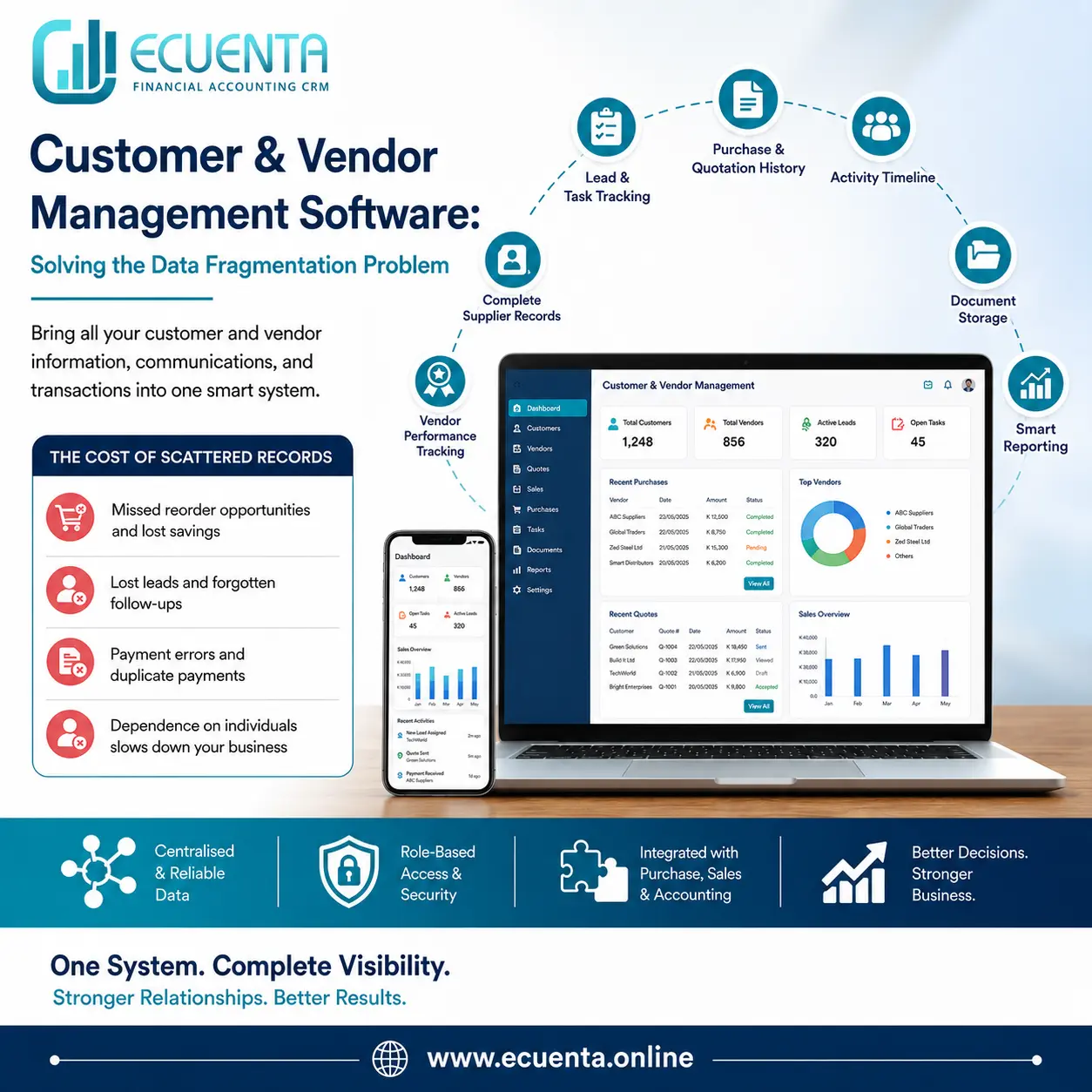
Solving the Data Fragmentation Problem with Customer & Vendor Management
Many businesses manage customer and vendor relationships across several disconnected tools. A notebook holds supplier contacts. A spreadsheet tracks purchase history. WhatsApp holds quotations. Everything else is left to memory. This setup works at a small scale. It breaks down as the business grows.
The Cost of Scattered Records
When customer and vendor data lives in separate places, problems build up quietly:
- Missed reorder opportunities. Without a clear record of past orders, quantities, and pricing, it is hard to negotiate better terms with a supplier.
- Lost leads. A customer inquiry sent through chat can be forgotten and never followed up.
- Payment errors. Without one shared record, vendors may be paid late or paid twice.
- Dependence on individuals. When information is stored in someone's memory or personal notes, the business stalls if that person is unavailable.
For a small business, these issues cause delays. For a medium or large business managing many vendors and customers, they create ongoing financial and operational risk.
What a Customer & Vendor Management System Solves
A dedicated customer and vendor management system brings these scattered records into one place. Instead of five separate tools, the business works from a single, shared source of information.
Complete Supplier Records
The system stores more than a contact name and number. It keeps a full history of past orders, pricing, payment terms, and the supplier representative the business has worked with before. This record supports better negotiation, since past pricing and order volume are always visible.
Purchase and Quotation History
Every purchase and quotation is recorded and searchable. There is no need to search through old messages to confirm a previous price. This reduces the risk of overpaying due to lost or forgotten quotations.
Lead and Task Tracking
New customer inquiries are logged, assigned, and tracked to completion. Each inquiry has a task record attached, so follow-up does not rely on memory. Sales teams can confirm exactly when a customer was contacted and what was discussed.
Activity and Interaction Timeline
Every call, meeting, and follow-up with a customer or vendor is logged against their profile. This creates a timeline that any team member can review, so a new staff member or a manager stepping in can see the full history of a relationship without asking around.
Document and Attachment Storage
Contracts, signed quotations, invoices, and other supporting documents can be attached directly to a customer or vendor record. This removes the need to search email inboxes or shared drives when a document is needed for reference or audit.
Integration with Purchase and Sales Records
Customer and vendor profiles connect directly to purchase and sales transactions. This means order history, outstanding payments, and past deals are visible in context, rather than requiring a separate lookup in the accounting module.
Multi-User Access with Permission Control
Multiple staff members can access the same customer and vendor database, with permission levels set according to role. Sales staff can be given access to leads and customer records, while finance staff can be given access to payment and vendor terms, without exposing the full database to every user.
Vendor Performance Tracking
Beyond storing contact details, the system tracks vendor reliability over time, including delivery consistency and pricing changes. This supports more informed decisions when comparing vendors or renewing supply agreements.
Standardised Communication
Email templates for quotations, follow-ups, and vendor communication keep messaging consistent across the team, regardless of who sends it.
Reporting
Vendor and transaction reports show which suppliers offer the most value and which customers generate the most revenue. This turns day-to-day decisions into decisions based on data rather than assumption.
Relevance to the Zambian Market
Supplier relationships in Zambia often depend on trust built over time, and pricing is frequently renegotiated in response to currency and fuel cost changes. A system that keeps supplier and customer records in one place helps protect margins during these renegotiations.
Centralised records also support compliance. Clean, organised transaction data is easier to prepare for Zambia Revenue Authority requirements than records reconstructed from scattered receipts and messages.
How the Benefit Scales
Small businesses gain a single, reliable record of customer and vendor obligations, replacing multiple notebooks and chat threads.
Medium-sized businesses gain shared access. Staff can view the same vendor and customer records, so information is not lost when an employee is unavailable or leaves the business.
Large businesses gain reporting at scale. With many vendors and a high volume of customer transactions, reports reveal patterns in supplier reliability, customer profitability, and process inefficiencies.
Frequently Asked Questions
Summary
Customer and vendor management connects sales, purchasing, and finance functions. When this connection is missing, the business loses negotiating leverage, misses leads, and loses visibility into its own operations.
Ecuenta's Customer and Vendor Management module addresses this directly. It gives businesses a single place to manage supplier relationships, track purchase history, log leads, assign tasks, and generate reports that support decision-making.
Request a free demo to see how centralised customer and vendor management can improve day-to-day operations.