
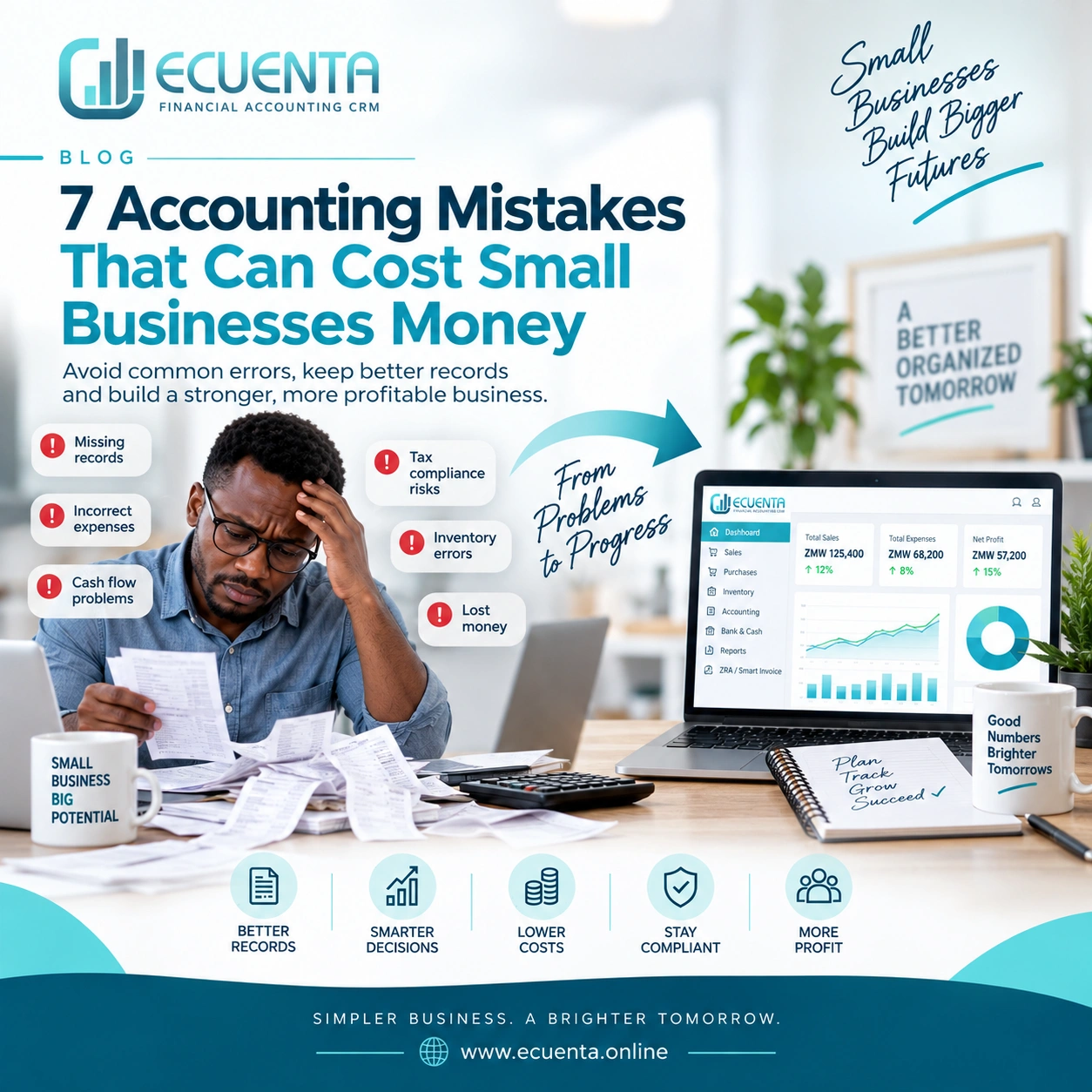
7 Accounting Mistakes That Can Cost Small Businesses Money
Accounting mistakes are errors in recording, classifying, tracking or reporting business finances that can lead to lost money, inaccurate reports, cash-flow problems or compliance issues. For small businesses, even seemingly minor bookkeeping errors can become expensive when they go unnoticed.
For Zambian small-business owners, keeping accurate financial records is about more than knowing whether the business made a profit. Good accounting helps you understand cash flow, control expenses, manage stock, collect payments and maintain proper tax records.
Here are seven common accounting mistakes small businesses should avoid.
1. Mixing Personal and Business Finances
Using the same bank account or cash for both personal and business expenses makes financial management unnecessarily difficult.
A business owner might pay for groceries from a business account or use business cash for a personal expense without recording it properly. Over time, these transactions make it harder to determine the company's actual income, expenses and profitability.
How to avoid it:
- Maintain separate business and personal accounts.
- Use a dedicated business card where possible.
- Record owner withdrawals and contributions correctly.
- Review transactions regularly.
Separating finances also creates cleaner records when preparing financial statements or working with an accountant.
2. Delaying Bookkeeping
One of the most common accounting mistakes small business owners make is waiting until the end of the month—or even tax season—to update their records.
When transactions accumulate, receipts can disappear, invoices may be forgotten and errors become harder to identify. A business may also make decisions using outdated financial information.
Instead, establish a consistent bookkeeping routine.
Record:
- Sales and customer payments
- Purchases and supplier payments
- Operating expenses
- Bank transactions
- Owner withdrawals
- Outstanding invoices
For growing businesses, accounting software for small businesses in Zambia can help centralise financial records and reduce repetitive manual work.
3. Misclassifying Income and Expenses
Not every transaction belongs in the same category. Incorrectly recording expenses can distort financial reports and make it harder to understand where money is going.
For example, consistently placing different types of expenses under a generic "miscellaneous" category can hide spending patterns that deserve attention.
Create a consistent chart of accounts and use the same categories for similar transactions.
This makes it easier to answer questions such as:
- How much did we spend on operating costs?
- Which expenses increased this month?
- How much revenue came from each business activity?
- Are our costs growing faster than sales?
Accurate categorisation also gives your accountant better-quality information when preparing financial reports and tax records.
4. Ignoring Cash Flow and Outstanding Payments
A business can report a profit and still experience a cash shortage.
This happens when customers owe money, payments are delayed or too much cash is tied up in inventory and unpaid invoices.
For example, if a business makes ZMW 100,000 in sales but customers have not yet paid most of those invoices, the business cannot necessarily use that ZMW 100,000 to pay its immediate bills.
To improve cash-flow visibility:
- Invoice customers promptly.
- Set clear payment terms.
- Track outstanding receivables.
- Follow up on overdue invoices.
- Monitor upcoming supplier payments.
- Review cash balances regularly.
Connecting sales, invoicing and financial records can also reduce the gap between making a sale and knowing its effect on cash flow.
5. Treating Inventory as Separate From Accounting
For retailers, wholesalers and distributors, inventory is closely connected to financial performance.
Poor stock control can lead to overstocking, stockouts, wastage, unexplained losses and inaccurate cost calculations.
Consider a retailer that records sales correctly but doesn't maintain accurate stock records. Its financial reports may show revenue, but management may not know whether the remaining inventory is correct.
A proper inventory management system can connect stock movements with sales and purchasing activity.
Regularly monitor:
- Opening and closing stock
- Stock purchases
- Sales
- Damaged or expired goods
- Stock adjustments
- Fast- and slow-moving products
Accurate inventory records give business owners a clearer picture of both stock and money tied up in products.
6. Skipping Bank Reconciliation
Bank reconciliation means comparing your accounting records with your bank statement to identify differences.
Skipping reconciliation can allow missing transactions, bank charges, duplicate entries or other discrepancies to remain unnoticed.
Make reconciliation part of your regular accounting routine. The appropriate frequency depends on transaction volume, but businesses with frequent transactions may benefit from checking their accounts more often.
Ecuenta includes bank reconciliation and cash-management tools that can support this process.
The goal isn't simply to make two numbers match. It is to understand why they don't match and correct the underlying records.
7. Overlooking ZRA Smart Invoice Requirements
For businesses affected by Zambia's VAT and electronic invoicing requirements, tax compliance is an important part of financial recordkeeping.
ZRA's Smart Invoice system is used for electronic invoicing by taxpayers covered by the applicable requirements. Businesses should make sure their invoicing process follows current ZRA requirements rather than relying on outdated manual processes.
This is particularly important when sales, invoices and accounting records are maintained separately.
A connected invoicing and accounting workflow can help reduce duplicate data entry and make it easier to maintain consistent transaction records.
Ecuenta provides ZRA-compliant Smart Invoicing as part of its business-management platform.
Businesses should still confirm their specific obligations and requirements directly with ZRA or their tax adviser.
How to Avoid Costly Accounting Mistakes
Most accounting mistakes are easier to prevent than to fix.
Start with a few simple habits:
- Keep business and personal finances separate.
- Record transactions consistently.
- Use clear expense categories.
- Monitor receivables and cash flow.
- Keep inventory records accurate.
- Reconcile bank accounts regularly.
- Keep your invoicing and tax processes aligned with current requirements.
As a business grows, managing these processes manually can become increasingly difficult. An integrated business-management system can connect areas such as accounting, sales, purchasing, inventory and invoicing instead of leaving each process in a separate spreadsheet.
Final Thoughts
Accounting isn't only about recording what happened yesterday. Accurate financial information helps small-business owners understand what is happening today and make better decisions about tomorrow.
By identifying these accounting mistakes for small businesses early, you can improve financial visibility, reduce avoidable errors and keep more control over your business finances.
If your business is still managing accounting, sales, inventory and invoicing across disconnected tools, explore how Ecuenta can bring these processes together in one platform.
Frequently Asked Questions
Common mistakes include mixing personal and business finances, delaying bookkeeping, misclassifying transactions, ignoring cash flow, failing to reconcile bank accounts and maintaining inaccurate inventory records.
The ideal frequency depends on the volume and complexity of transactions. Businesses with frequent sales and expenses should update records regularly rather than waiting until the end of the month or tax period.
Bank reconciliation compares accounting records with bank statements and helps identify missing transactions, duplicate entries, bank charges and other discrepancies.
Yes. Incorrect inventory records can affect the understanding of stock levels, cost of goods sold and business profitability. Accurate stock tracking is therefore important for businesses that sell physical products.
ZRA Smart Invoice is Zambia's electronic invoicing system used for taxpayers covered by the applicable ZRA requirements. Businesses should follow current ZRA guidance regarding registration, invoicing and compliance.
Accounting software can reduce repetitive manual data entry and help businesses organise transactions, invoices, expenses, sales and financial reports. However, software does not replace appropriate accounting procedures or professional advice where required.