
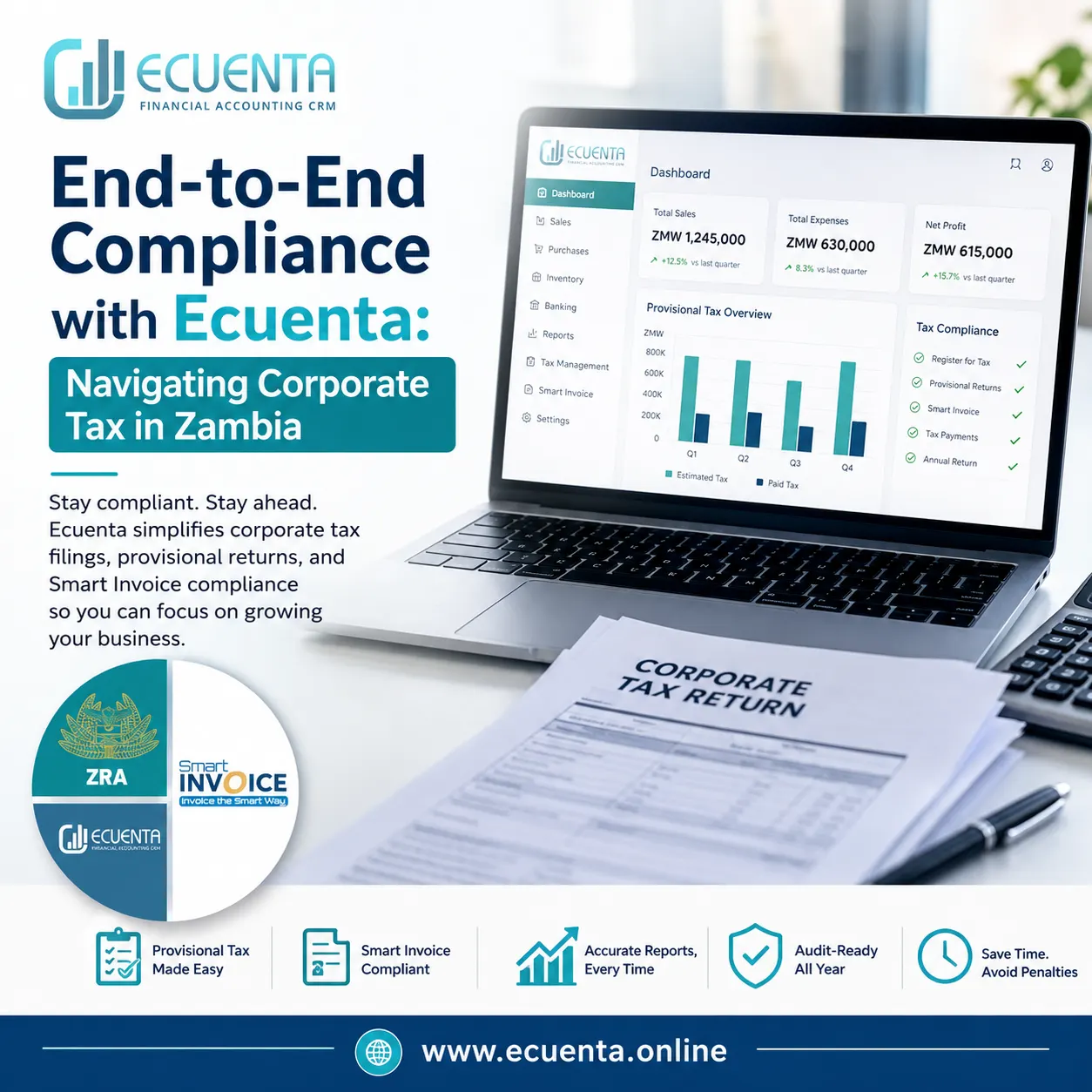
Navigating Corporate Tax Compliance in Zambia with Ecuenta
Corporate tax compliance is one of the most persistent operational burdens for businesses in Zambia. Between quarterly provisional returns, sector-specific rates, and the shift toward electronic invoicing, keeping a company's tax affairs in order takes more than a spreadsheet and good intentions. For small and medium enterprises in particular, a single missed deadline or miscalculated liability can trigger penalties that eat directly into working capital. This is where accounting software built for the Zambian tax environment, like Ecuenta, becomes less of a convenience and more of a necessity.
This guide breaks down what corporate tax compliance actually involves in Zambia, where businesses commonly go wrong, and how the right accounting system keeps a company audit-ready throughout the year rather than scrambling at filing time.
Understanding Corporate Tax Obligations in Zambia
The Zambia Revenue Authority (ZRA) administers corporate income tax (CIT) under the Income Tax Act. The standard CIT rate for most businesses is 30% of taxable income, though this varies by sector. Telecommunications companies are taxed at 35%, farming income attracts a reduced 10% rate, and businesses in certain value-addition industries qualify for lower preferential rates.
Smaller businesses have a separate path. Entities with annual turnover not exceeding ZMW 5 million fall under the turnover tax regime, paying a flat percentage on gross turnover instead of standard corporate income tax, with an exempt band for the lowest earners. This distinction matters because many growing SMEs cross the turnover threshold without realizing it, and continue filing under the wrong regime.
Zambia does not currently impose a capital gains tax, which simplifies certain transactions, but companies still need to track property transfer tax, withholding tax on payments to non-residents, and mineral royalty tax where applicable. For most service and trading businesses, though, CIT and its associated filing cycle are the main compliance burden.
The Provisional Tax Cycle Businesses Can't Afford to Miss
Corporate tax in Zambia is not a once-a-year event. Companies are required to submit provisional tax returns early in the charge year, estimating their taxable income, and then pay tax quarterly against that estimate. If a business's financial position changes significantly during the year, it can revise its estimate at the end of the second, third, or fourth quarter.
Each quarterly payment is due within days of the quarter's close, and while the ZRA allows a short grace period, interest and penalties accrue quickly once that window passes. The final return, reconciling actual results against the provisional estimates, is due mid-year following the close of the charge year, with an earlier deadline for businesses that file manually rather than electronically.
For a business tracking this manually, four separate quarterly calculations plus a year-end reconciliation is a lot of surface area for error. A single unrecorded invoice or misclassified expense can shift the estimate enough to trigger a penalty later.
Smart Invoice and the Shift Toward Digital Tax Administration
Zambia's tax administration has moved decisively toward digital compliance. The ZRA's electronic invoicing framework, formalized under Statutory Instrument No. 58 of 2023, requires businesses to issue invoices that integrate with the Smart Invoice system. This shift was audited by the ZRA in 2021 as part of the broader move toward real-time, verifiable transaction records.
Accounting platforms need to be built to work within this system, not bolted onto it as an afterthought. When invoicing, inventory movement, and financial reporting all feed from the same source data, a business's Smart Invoice submissions match its books by default rather than requiring separate reconciliation.
Where Businesses Commonly Fall Short
A few patterns show up repeatedly among Zambian businesses that run into tax trouble:
- Inconsistent record-keeping. Sales, expenses, and payroll tracked across different tools (or not tracked digitally at all) make it difficult to produce an accurate provisional estimate, let alone defend it if the ZRA raises a query.
- Confusing turnover tax and CIT eligibility. Businesses that grow past the turnover tax threshold sometimes continue filing under the old regime, creating a compliance gap that surfaces at audit.
- Treating quarterly filings as a formality. Provisional estimates are sometimes copied forward without adjustment, which either overstates liability (tying up cash unnecessarily) or understates it (creating a penalty at year-end).
- Manual VAT and CIT reconciliation. Because VAT (16% standard rate) and corporate income tax are reported separately but drawn from the same underlying transactions, manual bookkeeping often produces figures that don't tie out between the two.
How Ecuenta Supports Corporate Tax Compliance
Ecuenta is accounting and business management software built for the realities of operating in Zambia, including its specific tax filing structure. Rather than treating tax as a separate exercise from day-to-day bookkeeping, Ecuenta keeps sales, inventory, expenses, and invoicing in one connected system, so the numbers a business needs for its quarterly provisional return are already accurate and current, not reconstructed from scratch each quarter.
For invoicing, Ecuenta is built to work within Zambia's electronic invoicing requirements, supporting the Smart Invoice framework introduced under SI No. 58 of 2023. This means invoices generated through the system are structured to align with what the ZRA expects, reducing the manual re-entry that often introduces errors.
Because Ecuenta consolidates financial data across a business's operations, generating the reports needed to estimate provisional tax, or to reconcile the year-end return, becomes a matter of pulling existing records rather than compiling them under deadline pressure. For businesses managing hotels, retail operations, or distribution, where transaction volume is high and margins are tight, this kind of continuous, audit-ready record-keeping is what keeps corporate tax from becoming a quarterly crisis.
Practical Steps to Stay Compliant Year-Round
Regardless of the software a business uses, a few habits make corporate tax compliance manageable:
- Reconcile monthly, not quarterly. Waiting until a provisional return is due to review the books guarantees surprises.
- Revisit turnover projections regularly, especially for growing businesses near the ZRA's turnover tax threshold.
- Keep invoicing and bookkeeping in the same system so Smart Invoice submissions and internal records never diverge.
- Build in the grace period as a buffer, not a deadline. Treating the final payment date as the real deadline leaves no room for last-minute issues.
- Review sector-specific rate eligibility annually, since preferential rates and thresholds are periodically revised.
Conclusion
Corporate tax in Zambia rewards businesses that treat compliance as a continuous process rather than a quarterly scramble. The rules themselves, a 30% standard CIT rate, quarterly provisional filings, and Smart Invoice integration, are well defined. What trips businesses up is usually the gap between what their books say and what their tax filings claim. Closing that gap starts with accounting software that keeps financial records accurate in real time, so every provisional return and year-end reconciliation is built on numbers the business can already stand behind.
Learn more about how Ecuenta supports Zambian businesses at www.ecuenta.online.